The 100-Watt Moonlight: America’s Tiny Radio Stations Keeping Lunar Hours
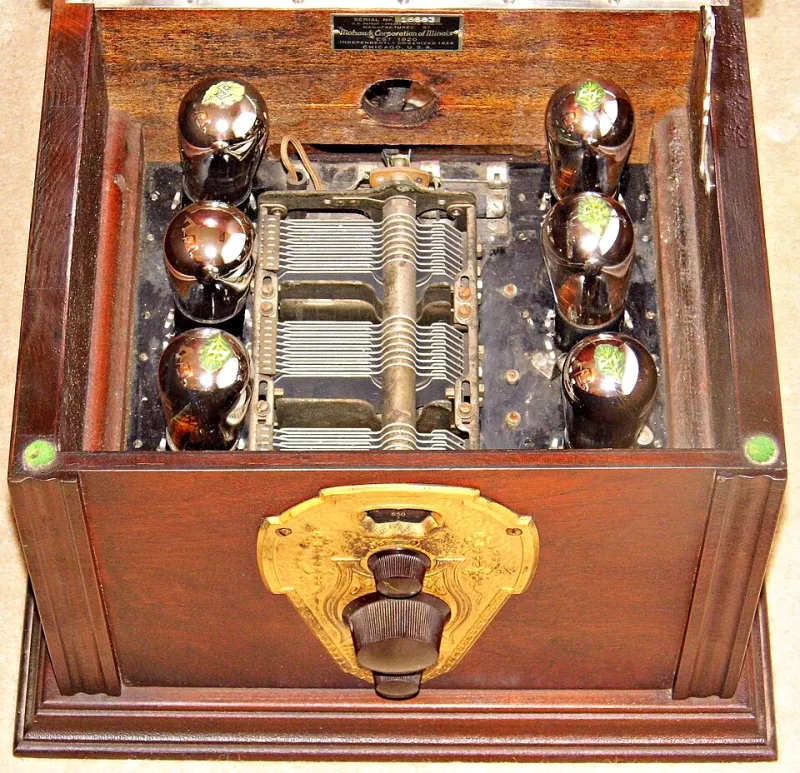
Photo: Joe Haupt from USA, CC BY-SA 2.0, via Wikimedia Commons
There’s a particular kind of quiet that settles over a car radio when the dial lands on a station you’ve never heard of. No corporate liner notes, no syndicated host counting down the hits. Just a voice, maybe a little crackly, saying something like: “The moon’s up over the ridge. Let’s settle in.”
That voice might belong to a volunteer at a low-power FM station—an LPFM, in FCC parlance—operating at 100 watts or less. These stations rarely reach beyond a few miles, and that’s the point. Across the U.S., a loose network of them has begun scheduling late-night programming around moonrise: ambient DJ sets, lunar folklore call-in shows, slow radio that unfolds at the pace of the night sky. The audiences are small. They are also deliberate.
The Dial as a Place-Based Ritual
Low-power FM wasn’t designed for lunar devotion. The service emerged from decades of grassroots broadcasting advocacy and was formalized by the FCC in 2000 to give community groups, schools, and local voices access to the airwaves. Most LPFM stations run on shoestring budgets, powered by volunteers and fundraisers. Their signal footprint is tiny—often just a town, a valley, a stretch of highway.
But that constraint has bred a certain intimacy. When a station can only reach a few thousand people, it stops pretending to be everything to everyone. Instead, it can be something specific: a Thursday-night ambient show, a Sunday folklore hour, a broadcast that begins when the moon clears the treeline.
In southern Appalachia, one station’s “Moonrise Frequency” program opens with a field recording of crickets and a single struck bell. The host, a former college radio DJ, plays mostly instrumental music—drone, fingerstyle guitar, dusty library records—and reads short listener submissions about the night sky. In the high desert of the Southwest, another LPFM airs a call-in show where people phone in to share lunar superstitions, family stories, and the occasional ghost tale. The signal only reaches the next town over, but the phone lines light up.
Slow Radio, By Design
What these broadcasts share is a refusal to hurry. There are no tight segues, no urgent talk breaks. A DJ might let a ten-minute track play out in full, then say nothing for a while. A folklore host might spend five minutes describing the phase of the moon before taking the first caller. It’s radio that trusts silence, and trusts the listener to stay.
That pace runs counter to most of what we stream. Algorithmic playlists optimize for retention; podcasts front-load the good stuff. Lunar radio does the opposite. It asks you to orient yourself to a schedule that isn’t yours—one set by the moon’s arrival, not by a content calendar.
“We sign on when the moon rises and sign off when we get tired,” one volunteer told me, laughing. “Sometimes that’s three hours. Sometimes it’s five. Nobody’s counting.”
The Audience That Tunes In on Purpose
It would be easy to dismiss these stations as charming anachronisms. But their listeners are not accidental. They are people who scan the dial looking for something local, something unpolished, something that feels like it exists in a particular place. In an era of infinite streaming, a 100-watt signal is a form of curation by geography. You can only hear it if you’re close enough. That scarcity makes the listening feel like an event.
Some tune in from bed, phone propped on a nightstand, earbuds in. Others listen in cars parked at overlooks, or on porch radios with the volume low. A few have made it a monthly ritual: full moon, same station, same show. The broadcasts don’t demand attention so much as offer company.
A Lunar Calendar for the Airwaves
Not every LPFM station programs by the moon, of course. Many are firmly diurnal—local news, high school sports, community bulletins. But the ones that do tend to organize their late-night slots around lunar phases. New moon shows might lean experimental and sparse; full moon broadcasts often go longer, looser, more communal. Waning moon programming might focus on repair, rest, or quiet instrumentals. It’s a subtle structure, but regular listeners notice.
That rhythm echoes the slow-living ethos that has gathered steam in recent years—a desire to sync daily life to something older than the clock. For these stations, the moon is not a gimmick. It’s a scheduling tool, a mood board, and a reason to gather a handful of neighbors on the airwaves.
Why It Matters After Dark
Low-power lunar radio won’t replace Spotify or NPR, and it isn’t trying to. Its value is in its scale: small enough to be human, local enough to feel like a secret, slow enough to remind you that not everything needs to be optimized. When the signal fades as you drive out of range, there’s a strange satisfaction in knowing you were briefly part of something contained.
So if you find yourself awake on a clear night, try scanning the lower end of the FM dial. You might catch a voice reading the moonrise time, a drone record fading into static, or a caller describing what the sky looks like from their backyard. It won’t last long. It isn’t supposed to. But for a few hours, the night gets a little less quiet—and a little more shared.