Booths Under Black Skies: A Late-Night Diner Guide to Watching the Moon
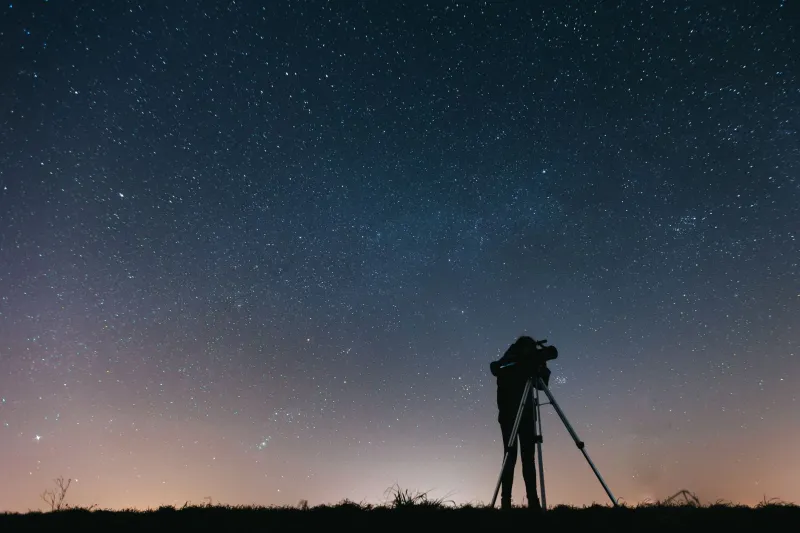
At 2 a.m., a diner is a strange and generous machine: fluorescent light, laminated menus, a coffee pot that has outlasted several decades of American optimism. In the dark-sky corners of the United States—west Texas, northern Nevada, rural Maine, the high desert of New Mexico, Michigan's Upper Peninsula—these rooms double as something else. They are waiting rooms for the sky.
The moon is the obvious draw, but the dark moon matters too. Near the new moon, when the sky is darkest, stargazers plan road trips around forecast maps and cloud cover. They need a base camp with hot food, weak coffee, and a bathroom that does not require a headlamp. The all-night diner becomes an accidental observatory: a place to thaw out, compare telescope notes, and wait for the next clear patch.
The Booth as Observatory
A good dark-sky diner does not advertise itself as one. There is no sign saying Astronomy Welcome. Instead, you notice small signals. A trucker nurses coffee near the door. A pair of astronomers in fleece jackets argues quietly over a star chart. Someone's tripod is leaning against the coat rack like an umbrella. The window booth is prized not because the view is good—usually it is a parking lot—but because the window is a boundary between the warm room and the cold sky.
That boundary is the whole point. Night shifts are lonely in a particular way. A diner gives that loneliness a shape: a booth, a menu, a server who refills your cup without asking. For astronomers, it is a place to decompress after hours of looking up. For truckers, it is a checkpoint. For hospital workers and factory hands, it is the only meal that counts as both dinner and breakfast. The moon does not care who you are. Neither, at 2 a.m., does a good diner.
A Short Field Guide to Dark-Sky Diners
You can learn a lot about a late-night café before you order. Here is what to look for.
1. The bulletin board. If there is a community board by the door, check it. Star charts, dark-sky festival flyers, and handwritten notes about telescope meetups are all good signs. So is a weather printout with cloud cover circled in pen.
2. The parking lot. A telescope or two is a strong hint. So is a car with red cellophane taped over its interior light. Astronomers learn to protect their night vision. A diner that tolerates the practice is a diner that understands its neighbors.
3. The coffee rhythm. The server should refill without hovering. You want a room that lets you sit, not a room that rushes you toward the check. At the same time, you do not want to be forgotten. The best late-night servers have a sixth sense for when a booth needs company and when it needs silence.
4. The pie case. A rotating pie case is not strictly astronomical, but it helps. Pie at 2 a.m. is a ritual food. It says you are staying for a while, and you are not sorry about it.
5. The shift-change grace. If the staff is changing over, pay attention. A good diner will tell you whether the kitchen is closing or the coffee will keep coming. A great diner will let you stay if you are quiet and tip well.
The Etiquette of Staying Late
Dark-sky diners are not observatories with table service. They are workplaces, and the etiquette is mostly about not making your night someone else's problem.
Ask before you claim the window booth. If the place is busy, take the counter. Use a red flashlight, not your phone's white screen. If you go outside to look up, close the car door quietly and do not wash the parking lot with headlights. Order something every hour or so if you are camping out. Tip for the time, not just the coffee. And if the server says the room is turning over, believe them.
The hardest rule is the simplest: do not rush the room. Late-night diners run on a different clock. The cook is not trying to stage a tasting menu. The server is not trying to turn tables. The person in the next booth may be on a break from a twelve-hour shift or may be waiting for the moon to rise over the ridge. The point is not efficiency. The point is permission.
How to Order Without Rushing the Room
At 2 a.m., the menu is a suggestion, not a challenge. Coffee, pie, eggs, toast—this is the sacred trinity. If you are staying for hours, ask for a thermos rather than a fourth refill. If you are with a group, order together so the kitchen can work in one rhythm. Cash is kind, especially for a small check. And if the coffee is bad, do not announce it. Bad coffee at 2 a.m. is not a failure of the bean. It is part of the room's weather.
That is the cosmic hospitality of the place. A perfect cup would be nice, but it would also be beside the point. The diner is offering something rarer: a lit window in a dark landscape, a booth with a view of nothing, and a server who lets you sit with the moon on your mind. In a country that often mistakes speed for care, that is a small act of grace.
So bring a star chart if you have one. Bring layers. Bring cash for pie. And when the sky clears, step outside, let your eyes adjust, and remember that the best observatory in America might be the diner you almost drove past.