Silver Leaf, White Bloom: Designing a Garden for the Hours After Sunset
The first time I understood what a moon garden was, I was standing on a gravel path in someone else’s backyard at 10 p.m., waiting for my eyes to adjust. There was no floodlight, no tiki torch, just a border of white nicotiana and a row of lamb’s ears catching the moon like a low-grade mirror. It was not spectacular. It was better than spectacular—it was quiet.
That is the promise of the moon garden, a landscape designed to be visited after dinner rather than during the day’s errands. The idea has roots in several traditions, and it is enjoying a fresh life among American gardeners who want less lawn, less glare, and more reasons to step outside at night.
A Short History of Planting for Moonlight
Moon viewing is ancient. In Japan, tsukimi—autumn moon viewing—has for centuries paired the full moon with pampas grass, sweet potatoes, and quiet company. In the American South, porch gardens of four-o’clocks and moonflower vines were a grandmotherly staple long before anyone called it design.
The moon garden as a deliberate composition, though, owes a lot to the early twentieth century. Vita Sackville-West’s white garden at Sissinghurst, planted in the 1930s, showed that a border could be built for dusk: white roses, silver artemisia, pale delphiniums, all of it glowing as the light failed. Mid-century American garden writers picked up the thread, recommending white petunias, flowering tobacco, and dusty miller for what they called moonlight gardening. Then the idea drifted out of fashion, too fussy for the low-maintenance lawn era.
Why the Revival Feels Different Now
Today’s moon gardens are less about formal white borders and more about atmosphere. Landscape designers in Austin and Portland are specifying silver foliage for heat and drought tolerance as much as for shimmer. Slow-living readers are drawn to a garden that asks to be visited after the dishes are done, not squeezed between errands. And a new generation of gardeners, raised on screens, seems to like the idea of a landscape that only fully arrives when the sun is gone.
There is also a practical appeal. Many night-blooming plants are pollinator plants. Moths, in particular, follow fragrance and pale color. A moon garden is not just a mood; it is a small act of habitat restoration.
Artists Have Always Known
Moonlight is a collaborator. The nineteenth-century American Luminists painted harbor scenes in which the moon does half the work, silvering water and softening every edge. Contemporary light artists take the opposite approach—Bruce Munro’s field installations and James Turrell’s skyspaces build rooms for watching the sky change. A moon garden sits between those impulses: it is a living installation, tuned to a cycle rather than a switch.
That is why visual artists keep returning to the night garden as a subject. It is never the same twice. The full moon washes out detail; the new moon gives you silhouettes; a waxing crescent gives you about twenty minutes of usable magic before the sky goes black.
Public Gardens to Visit After Dark
You do not need your own backyard to study the form. A number of American public gardens now stay open late on select evenings, and several have planted expressly for dusk.
Longwood Gardens in Kennett Square, Pennsylvania, has a long history of evening display and lighting design; its conservatory and outdoor gardens are worth a trip when night hours are offered. The Chicago Botanic Garden’s Evening Island was designed with dusk in mind, and the Desert Botanical Garden in Phoenix runs night programs where you can see cactus blooms and night-flying pollinators in action. The Portland Japanese Garden and Wave Hill in the Bronx both reward a late-afternoon ticket that stretches into twilight. Check each garden’s calendar before you go—night hours are often seasonal and ticketed.
What to Plant
The palette is simple: white flowers, silver foliage, and fragrance.
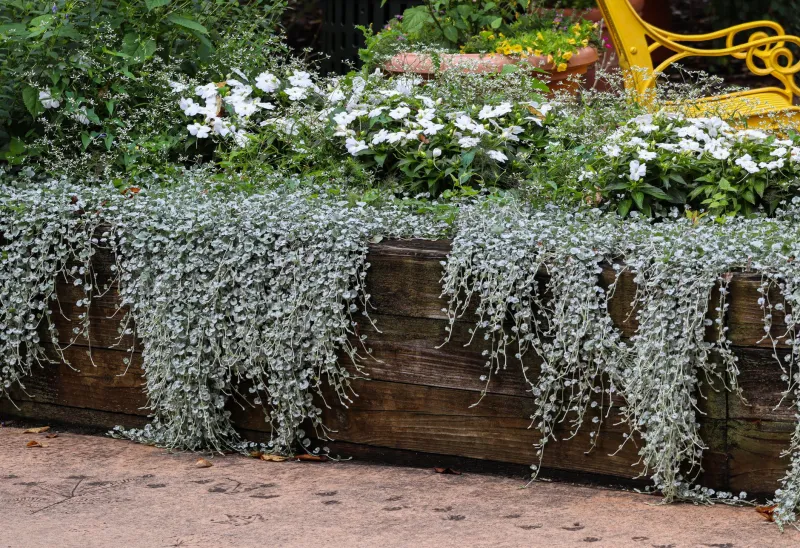
For white blooms, start with flowering tobacco (Nicotiana alata), moonflower vine (Ipomoea alba), evening primrose, white cosmos, and Shasta daisies. For silver and gray foliage, lamb’s ears, Artemisia ‘Powis Castle’, dusty miller, and lavender all earn their place. Add night-scented stock or tuberose if you want the garden to announce itself before you see it.
Design-wise, pale gravel and light-colored stone paths do a lot of the work, reflecting whatever light is available. A birch trunk or a white bench gives the eye something to land on. Plant in drifts rather than single specimens—moonlight favors mass and repetition.
Lighting Is Not the Point
This is the part people get wrong. A moon garden is not a lighting project. Floodlights flatten the effect. Instead, use low, warm path lights—2700K or warmer—or solar stake lights that mark the edge of a walk without competing with the sky. Candles in glass are fine. A fire pit is better. The goal is to let your eyes adjust, not to replicate noon.
A Practice, Not a Project
A moon garden rewards patience. Plant for succession so something is always open at dusk. Keep a notebook. Notice which flowers stay open past midnight and which close at nine. Go out on the full moon and again on the new moon, and see how different the same border can feel.
That is the slow-living argument for the moon garden: it gives you a reason to go outside when there is nothing to do. No weeding, no watering, no agenda. Just a gravel path, a white flower, and a moon doing its old work.